



The Hidden Cost of Telecom NOC Incident Response: Cross-Team Coordination
Most telecom incidents are detected within seconds. Teams often spend more time coordinating the response than fixing the underlying issue.
Monitoring tools generate alerts quickly. In telecom NOC incident response, the technical capability to identify that something is wrong is rarely the bottleneck. The constraint is the coordination layer that follows detection — assembling shared context across support, NOC, engineering, and leadership, each of whom needs different information from the same event, from different systems, in real time.
1. The Coordination Tax
Every manual handoff during telecom NOC incident response has a cost. Support contacts NOC to understand scope. NOC contacts engineering to confirm the root cause. Engineering compiles findings for leadership. Each handoff is sequential. Each introduces delay. And each occurs while the incident is still active.
Deciding where to look, correlating symptoms across tools, repeating the same drill-down steps, and translating technical detail for leadership — each of these adds time while the incident is still active. That overhead does not appear as a distinct line item in most post-incident reports. It is absorbed into total resolution time and attributed to incident complexity.
It is not complex. It is structured.
2. Telecom NOC Incident Response: What the NOC Sees vs What Each Team Needs
NOC receives an alert. SolarWinds identifies that interface utilization has exceeded a threshold. That information is accurate. It is also incomplete for every other team involved in the response.
Support needs to know which customers are affected and whether complaint volume is already rising. Engineering needs cross-system datasets — SNMP, traffic trends, service-impact context — time-synced and correlated. Leadership needs a service impact summary in operational language, not a raw alert export.
None of that exists until someone builds it. In most environments, that someone is NOC — fielding calls from support, fielding requests from leadership, and managing the technical response at the same time.
3. Technical Use Case: Without a Coordination Layer
A mid-sized operator experiences degradation across a regional segment. NOC identifies elevated utilization on a core link. Support begins receiving tickets but cannot confirm scope. Engineering opens Grafana separately. A manager requests a status update.
Thirty minutes in, the teams establish a shared understanding. They then discover this is the third occurrence on that same segment in six weeks. The previous two incidents were resolved and closed, but the pattern was never identified because the history existed in separate systems that no one cross-referenced during an active event.
4. How a Coordination Layer Changes the Response
When a coordination layer provides role-specific context automatically, the response process changes.
NOC receives correlated KPI movement and historical pattern from the first minute, and stays focused on resolution instead of fielding status requests. Support sees affected geography, complaint trend, and repeat-issue flags immediately, without waiting for NOC to confirm scope. Engineering receives linked SNMP, traffic, and service-impact datasets with prior-incident pattern matches already attached, rather than reconstructing cross-system context manually. Leadership receives a service impact report generated from the same underlying data, with no one pulled away to compile it.
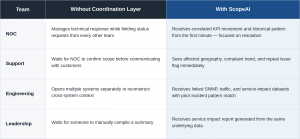
In the scenario above, the recurring segment fault would surface on the first alert, not thirty minutes in. ScopeAI addresses this gap directly — not as a replacement for existing monitoring tools, but as a layer above them that eliminates the manual translation work between detection and coordinated response.
Conclusion
The hidden cost of telecom NOC incident response is rarely detection — it is the manual correlation work between tools and teams. The operators that reduce that overhead will resolve incidents faster, not by changing what they monitor, but by changing how that information reaches the people who need to act on it.
That is the problem ScopeAI is designed to address.

Leave a comment