



Orchestrating the Autonomous Network: Technical Architecture and Observability in 2026
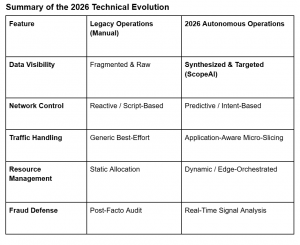
By 2026, the global telecommunications industry has surpassed the “Level 3” autonomy threshold. Operators are no longer managing static pipes; they are managing dynamic, intent-based environments where the network infrastructure self-optimizes in real-time. This shift is driven by the need to manage the exponential complexity of 5G-Advanced and 6G-ready architectures.
1. The Synthesis Layer: Bridging Telemetry and Business Intelligence
In the legacy model, platforms like ActiveLogic (formerly Sandvine) provided massive volumes of flow-based telemetry. However, this data often existed in a technical vacuum. In 2026, the focus is on Synthesized Observability, where the goal is to extract “Actionable Scope” from raw packet data.
Technical Use-Case: The ScopeAI Workflow
ScopeAI serves as the synthesis engine that bridges the gap between raw DPI exports and multi-stakeholder visualization.
- Data Ingestion & Normalization: ScopeAI ingests high-velocity exports from ActiveLogic and other infrastructure logs. It normalizes this data, stripping away the noise of encrypted headers while retaining flow-state signatures.
- The “Dual-Dashboard” Logic: * The Micro-Service View (Grafana-Style): For the network engineer, ScopeAI provides millisecond-level visibility into Jitter, Latency, and Packet Loss per network slice. If a specific 5G slice for “Autonomous Hauling” in a mining site begins to experience latency spikes, the engineer sees the exact flow-state anomaly.
- The Macro-Business View (Tableau-Style): For the executive, the same raw data is synthesized into Subscriber Lifetime Value (LTV) and Churn Probability. ScopeAI identifies that a 10ms increase in latency for a “Gamer” segment correlates to a 15% increase in churn, allowing the CFO to justify an immediate edge-node upgrade.
- Outcome: Data is no longer “just a report”; it is a tailored lens that aligns technical performance with financial health.
2. Closed-Loop Automation & Heuristic Remediation
The “Complexity Wall” of 2026 makes manual Network Operations Centers (NOCs) obsolete. The industry has moved to Closed-Loop Automation, utilizing the Sense-Analyze-Decide-Act (SADA) framework.
Technical Use-Case: Predictive Fault Recovery
Instead of waiting for a threshold alert to trigger a human response, the network uses Heuristic Models to predict failures before they manifest.
- Sensing: The system monitors real-time signaling data (SS7/Diameter) and environmental telemetry (e.g., cell site battery temperature and fan speeds).
- Analysis: Machine Learning models identify patterns associated with “Pre-Failure States.”
- Decide & Act: If the system predicts a hardware failure at an Ontario-based cell site within 24 hours, it automatically:
- Reroutes traffic to adjacent nodes to minimize the blast radius.
- Triggers an automated work order for a technician.
- Throttles non-essential background traffic (e.g., cloud backups) to prioritize emergency services.
- Metric Impact: This “Self-Healing” capability has reduced Mean Time to Repair (MTTR) by 40% and virtually eliminated “Silent Failures” where users lose connectivity without an official outage being logged.
3. Precision QoE and Behavioral Traffic Classification
With over 95% of traffic now fully encrypted, traditional Deep Packet Inspection has evolved into Behavioral Classification.
Technical Use-Case: Dynamic Micro-Slicing
Carriers in 2026 are monetizing Quality of Experience (QoE) rather than just volume (GB).
- The Methodology: Models analyze packet timing, size distribution, and flow-directionality to identify the application type. For example, it can distinguish between a high-bandwidth 4K video stream and a low-latency, high-priority Telemedicine uplink.
- Execution: Upon identifying a high-priority session, the network orchestrator dynamically triggers a Micro-Slice. This slice reserves a specific portion of the RAN (Radio Access Network) resources and assigns it a dedicated QoS Class Identifier (QCI).
- Revenue Generation: Platforms like ScopeAI can then report on the “Experience Upsell.” If a subscriber is identified as a “Power User,” the system can automatically offer a temporary “Experience Boost” during peak congestion, converting network performance directly into ARPU (Average Revenue Per User).
4. Advanced Security: Real-Time Fraud & Signaling Defense
Telecom fraud remains a multi-billion dollar threat. In 2026, security is handled at the Signal Layer rather than the Perimeter.
Technical Use-Case: SIM Box and Bypass Fraud Detection
- The Mechanism: Fraudsters use “SIM Boxes” to terminate international calls as local calls, bypassing interconnect fees.
- The Solution: The network employs Real-Time Anomaly Detection. It monitors for high-frequency call attempts from a single IMEI with shifting cell-tower associations.
Impact: By synthesizing signaling data with geolocation and call-duration heuristics, these illegal gray-routes are identified and shut down within seconds of activation, protecting the carrier’s wholesale revenue.
Conclusion
The transition to the Autonomous Network is ultimately a transition to Intelligence Synthesis. By moving away from siloed technical data and utilizing platforms like ScopeAI to deliver role-specific insights, telecommunications providers are finally achieving the operational efficiency and revenue flexibility required for the 6G era. The network is no longer a “dumb pipe”—it is a self-aware, value-generating ecosystem.

Leave a comment